Scent as Knowledge
The Tilted Chair

Scent as a Form of Knowledge
Imagine entering a quiet room in which nothing visible explains what you are feeling, yet something unmistakable is taking place. Before language forms, before interpretation begins, perception has already organized itself into recognition. A scent encountered in such a space does not simply accompany experience; it structures it. It alters the atmosphere of memory, clarifies emotional states, and establishes a mode of understanding that operates prior to explanation.
Scent is often treated as atmospheric or decorative — an enhancement to environments already defined by sight and sound. Yet this understanding obscures its more consequential function. Olfactory perception is not merely aesthetic; it is epistemological. It is a means by which we come to know, remember, and interpret emotional life. It communicates with a precision that does not depend upon narrative and often precedes it.
The work gathered under The Tilted Chair begins from this premise: that scent functions as a form of language and as a form of knowledge. It carries memory with unusual fidelity, communicates emotional states without recourse to explanation, and produces forms of understanding that are felt before they are articulated. When encountered with attention, scent reveals itself as both material and idea — a medium through which emotional and intellectual life may be examined.
To speak of scent as knowledge requires a shift in how perception itself is understood. Much of contemporary culture privileges what can be seen, named, and immediately interpreted. Vision is treated as primary; language as the means by which experience is stabilized and shared. Yet olfactory perception operates according to a different logic. It does not describe; it evokes. It does not present a narrative; it summons one. It does not ask to be analyzed before it is felt. Instead, it enters consciousness as a fully formed recognition whose origins are often located in memory and emotional life rather than in present circumstance.
A familiar fragrance encountered unexpectedly may recall a specific place, a person, or a moment long past. Such recollection occurs with a clarity and immediacy that exceeds what visual or verbal prompts typically produce. The memory arrives intact — not as a sequence of events but as an emotional atmosphere. One does not remember about the past; one briefly inhabits it. In this way, scent functions less as representation and more as retrieval. It is an archive that does not store information as narrative but as lived sensation.
This capacity reveals scent to be a cognitive medium. It organizes perception and memory in ways that structure emotional understanding. The knowledge it produces is not propositional; it cannot always be translated into declarative statements. Yet it is nonetheless precise. One may not be able to explain why a particular fragrance produces a feeling of calm or unease, but the recognition of that state is immediate and unmistakable. Scent communicates directly with emotional awareness, bypassing the explanatory frameworks through which we typically attempt to understand ourselves.
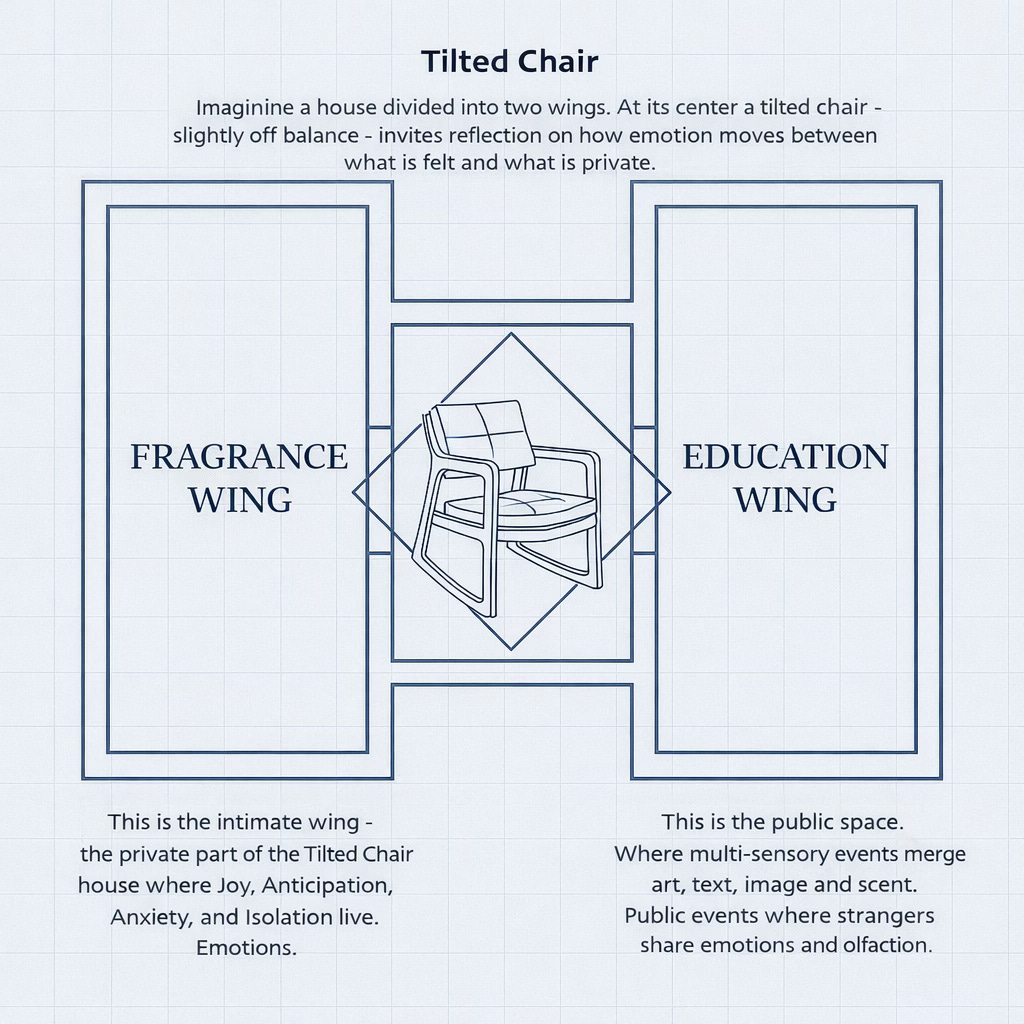
Such communication suggests that emotional life possesses a structure that can be perceived and, at times, stabilized through olfactory experience. Joy, anticipation, anxiety, and isolation — among other states — are not merely internal sensations but atmospheres in which individuals move. They shape perception and memory, influence behavior, and define how environments are experienced. When rendered through scent, these emotional structures become perceptible in a new way. They can be encountered, examined, and, in certain contexts, shared.
To consider scent as language is therefore not metaphorical but descriptive. Like language, it conveys meaning, evokes response, and establishes relationships between individuals and their environments. Yet it does so without relying on grammar or syntax. Its vocabulary consists of materials and accords; its grammar is the interplay of memory and sensation. Where spoken or written language organizes thought through sequence, scent organizes it through simultaneity. A single inhalation may contain layers of reference — temporal, emotional, and spatial — that unfold at once.
Within artistic and curatorial contexts, this capacity allows scent to function as both medium and method. It can shape environments in which perception is directed toward forms of understanding that precede explanation. Installations incorporating fragrance, text, and spatial design demonstrate how scent alters the experience of place and time. A room subtly infused with a particular accord may evoke a sense of anticipation or stillness; textiles treated with fragrance may hold emotional resonance that extends beyond their visual presence. In such settings, scent becomes an organizing principle — a means of structuring how individuals encounter memory and emotion within shared space.
My own work emerges from sustained engagement with these questions. I hold a PhD and work as a perfumer and multidisciplinary artist whose practice centers on scent as a medium of emotional and intellectual inquiry. Over time, this work has taken the form of fragrances, installations, and written texts that examine how olfactory perception shapes memory and emotional awareness. Exhibitions and collaborative projects have explored the relationship between scent, language, and spatial experience, inviting participants to encounter fragrance not as commodity but as a form of thought.
The Tilted Chair has been established as a place in which this inquiry may unfold with clarity and continuity. It is not conceived as a newsletter or as a platform for commentary, but as a permanent intellectual and artistic record. Essays, poetic texts, and documentation of artistic work will appear here as part of a cumulative investigation into how scent functions as language, memory, and knowledge. Publication will proceed slowly and with intention. Each text is intended to stand as a considered contribution to a coherent body of work rather than as an isolated reflection.
Such an approach responds to the tempo required by the subject itself. The study of scent and emotional life resists immediacy. It asks for sustained attention, for repeated encounter, and for the gradual accumulation of insight. Contemporary digital publishing often favors speed and visibility; this project proceeds differently. It is structured as a curatorial house in which ideas and works are gathered thoughtfully and allowed to remain. Over time, the texts assembled here will form a philosophical and artistic archive concerned with perception, memory, and emotional understanding.
To enter this space as a reader is therefore to enter an ongoing inquiry. The essays that follow will examine scent as both material and concept: as a carrier of memory, a communicator of emotional states, and a medium through which forms of knowledge emerge that cannot be fully expressed through narrative alone. Artistic documentation will accompany these reflections, offering visual and textual records of installations and fragrances as they develop. Together, these elements will constitute a sustained exploration of how perception shapes meaning.
Scent is ephemeral by nature. It disperses, fades, and reappears in altered form. Yet the knowledge it carries endures. Memories summoned through fragrance remain accessible long after the material presence of the scent has dissipated. Emotional recognitions prompted by olfactory experience often persist with unusual clarity. This paradox — of transience coupled with precision — renders scent uniquely suited to the examination of memory and emotional life.
The Tilted Chair exists to pursue that examination with care. It is offered as a quiet but deliberate contribution to ongoing conversations about perception, language, and artistic practice. What unfolds here will do so gradually, through texts and works that attend closely to the ways in which scent structures understanding. Over time, a body of thought will gather: one that treats olfactory experience not as accessory to life, but as one of its most exact and revealing forms of knowledge.